The Game Loop
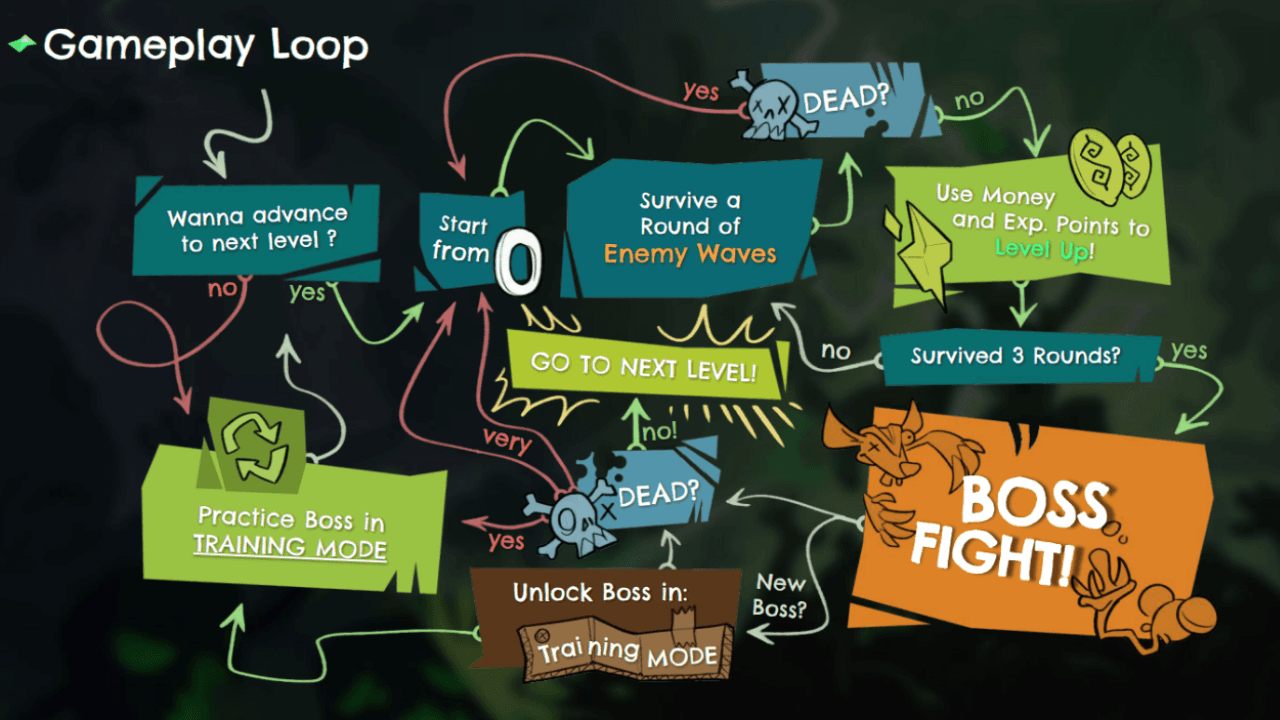
If that flowchart looks confusing, don’t worry. We’ll explain.
The quick version is this:
You enter an arena > survive enemy waves > collect resources > upgrade your character > unlock the next Boss Fight > try to defeat that Boss to move forward.
Each level is split into 3 Acts, and each Act follows a similar structure: fight through a Gauntlet, survive long enough to reach the Boss, then defeat that Boss to advance.
So the game keeps switching between two main modes:
Enemy Wave Mode, where you fight through chaotic arena gauntlets.
And Boss Fight Mode, where you face a unique Boss with its own attack patterns, animations, and rewards.
As you progress through the level, the enemy waves become harder, your character becomes stronger, and the challenges start demanding better builds, better reactions, and better strategies.
Between Rounds, you get time to return to your base, adjust your build, upgrade your attributes, craft equipment, and prepare for whatever comes next.
That’s the overall structure. Now let’s break it down.
Enemy Gauntlets
If you’re a Hollow Knight fan, you might have already noticed a few similarities.
That game is one of our biggest inspirations. We love how Team Cherry handles precise combat, dynamic enemies, hand-crafted animation, and the way each encounter teaches you something new.
For this part of Skroyder Rumble, one of our biggest references is the Colosseum of Fools.
In that section, enemies spawn in a specific order, and you need to survive until the end of the challenge.
We really like that idea because it lets us handcraft enemy combinations instead of just throwing random monsters at the player. A carefully designed Wave can create a very specific type of pressure, forcing you to move, dodge, attack, block, or prioritize enemies in different ways.
But at the same time, we didn’t want the game to feel too linear or predictable. So we decided to add a little twist.
When you enter an arena to fight a Gauntlet, the doors lock and enemies start spawning. You can only leave after defeating the final enemy of that Round.
But each Round is made of 2 separate Waves.
A Wave is a fixed sequence of enemies. That means the Wave itself does not change, so you can learn it, master it, and get better at dealing with it over time.
But the Round can shuffle which Waves appear, picking them from a small pool of possible Waves.
So the structure is not completely random, but it is also not always exactly the same.
You get a bit of unpredictability, without losing the handcrafted feel.
And after completing the first Wave of a Round, you get a short break where you can choose what comes next.
This choice is important because it lets you influence the challenge a little bit.
Maybe one Wave gives you more resources. Maybe another one is riskier but has a better reward. Maybe you just really hate a specific enemy combination and want to avoid it for now.
That is the balance we’re aiming for: enough variation to keep the runs interesting, but enough consistency that players can learn, improve, and eventually master each part of the game.
Once you complete a full Round without dying, the arena opens again and you can return to your base.
There, you can swap your loadout, upgrade your attributes, craft new equipment, unlock talismans, and prepare for the next challenge.
Survive enough Rounds, and eventually you unlock the main event of the Act.
The Boss Fights
This is the big moment of each Act. The big baddie. The cool animations. The unique attack patterns. The big reward waiting at the end.
The Boss!
Once you survive enough Gauntlets to reach a Boss, that Boss becomes a kind of checkpoint. Even if you die, you will be able to challenge it again without having to replay all the previous Gauntlets.
This is what we currently call Cardboard Mode.
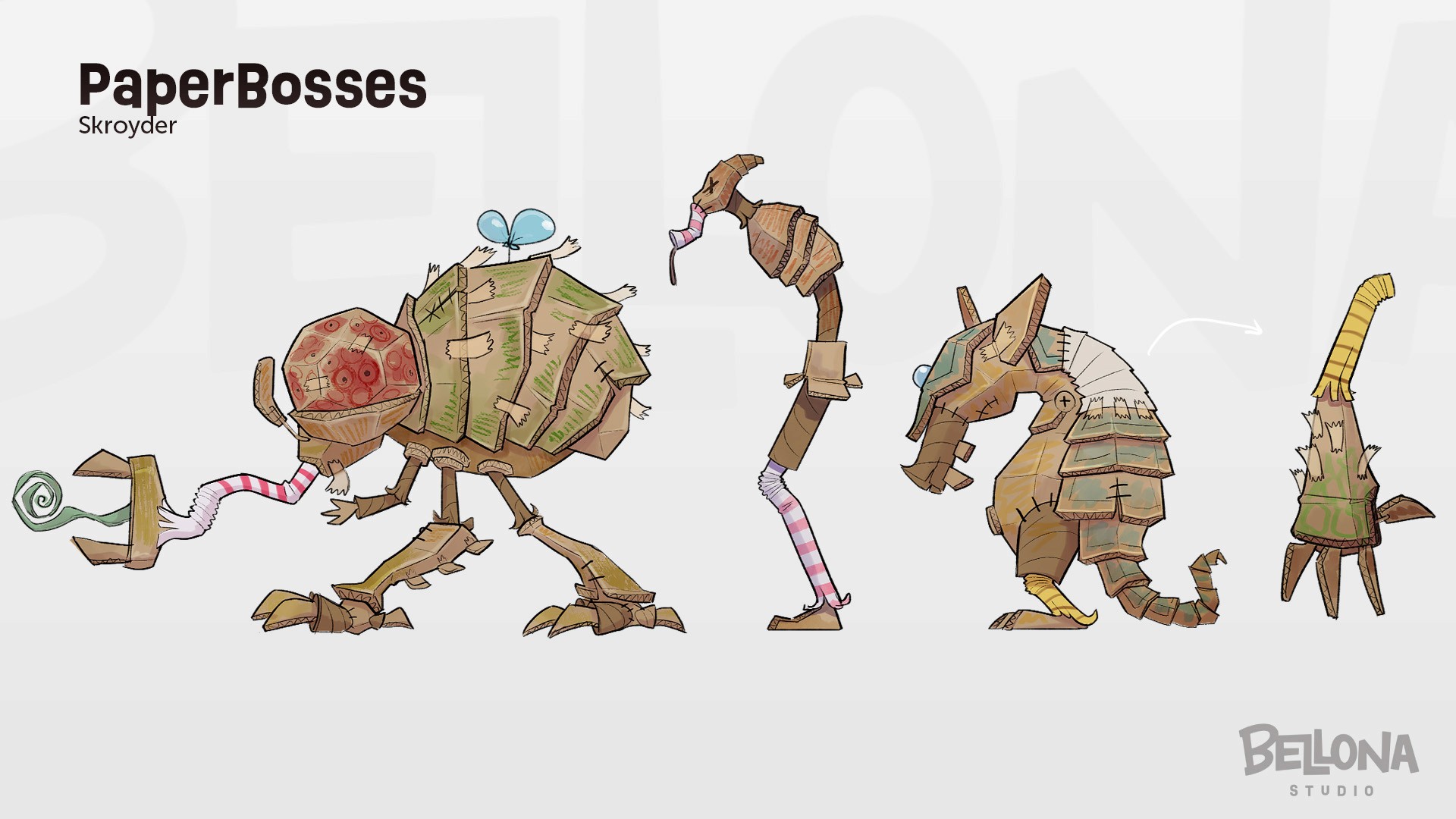
In Cardboard Mode, you fight a slightly different version of the Boss.
Yes. A cardboard version.
Because apparently, even our training dummies need a custom skin.
Mechanically, it still works the same, so you still need to learn the attacks, react properly, and actually defeat it.
The difference is in the rewards.
Fighting the Boss inside a full run and defeating it there will give better rewards than fighting it directly through Cardboard Mode after you’ve already unlocked it.
This way, more hardcore players get something extra for pushing through the full challenge, while more casual players can keep progressing without being forced to repeat the same Gauntlets over and over again.
That balance is really important to us.
We want Skroyder Rumble to feel challenging and satisfying, but not exhausting.
So, to summarize:
Every level is composed of 3 Acts. Each Act has its own Gauntlet followed by a Boss Fight.
And each Boss will have its own personality, fighting style, attack rhythm, animations, visual effects, and rewards. And the final Boss of each level will always bring something a little extra.
What Comes Next
In the next update, we’ll dive deeper into the combat itself.
We’ll talk about Benny’s different attacks, their variations, the difference between offensive and defensive tools, and how different enemy types ask for different strategies.
And if you liked what you saw so far, please consider wishlisting Skroyder Rumble on Steam.
It helps us a lot, and it’s the best way to let Steam know that people want to see more of our weird little boss-fighting banana-powered chaos.
See you next week!
Sign up for our Mailing List!
Would like to get notified the next time a blog post goes live, or to get early access to a playtest?
Follow us on social media:





Copywrite © 2026 Bellona Computacao Grafica Ltda